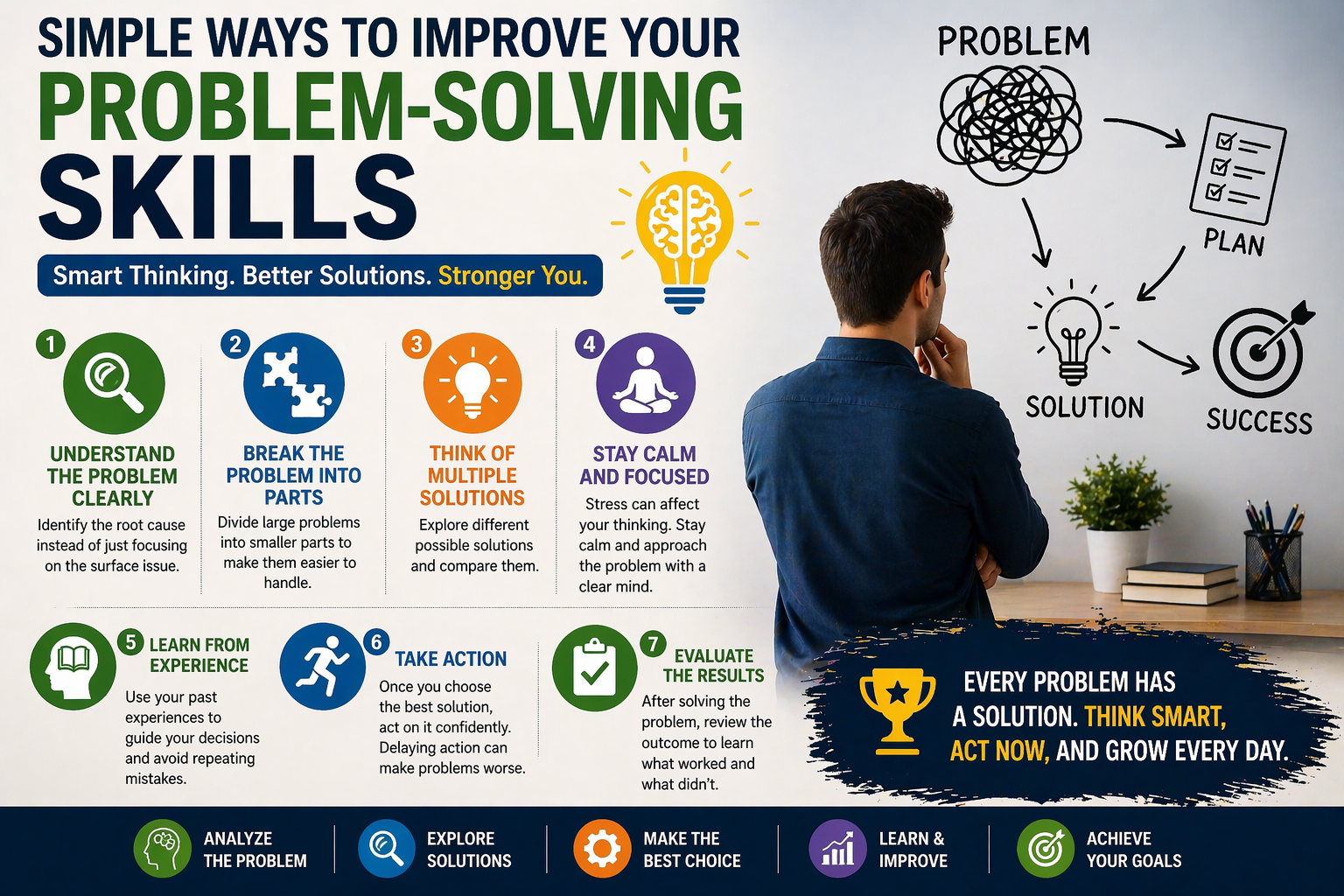
Simple Ways to Improve Your Problem-Solving Skills
Solving problems ,definitely,matters deeply in life ,and in work.
Every day, we face different challenges that require smart thinking and effective solutions.
Ways to Improve Your Problem-Solving Skills
Improving your problem-solving skills can help you make better decisions and handle situations with confidence.
Understand the Problem Clearly
Before finding a solution, take time to fully understand the problem.
Identify the root cause instead of just focusing on the surface issue.
Rushing straight to a fix without understanding the real cause often leads to wasted effort, repeated mistakes, and bigger issues down the line.
A manager who asks why did this happen before acting can reach the real cause while one who jumps straight to a fix can solve the wrong thing entirely.
Break the Problem into Parts
Large problems can feel overwhelming.
Divide them into smaller parts to make them easier to handle.
Splitting a big challenge into clear steps, smaller tasks, or separate questions makes each piece something you can actually work on right away.
A student who breaks a tough assignment into research, outline, writing, and review can finish it calmly while one who stares at the whole task can feel too stuck to even begin.
Think of Multiple Dilutions
Don’t rely on just one idea.
Explore different possible solutions and compare them.
The first answer that comes to mind is rarely the best always push yourself to consider at least two or three options before making a final choice.
Someone facing a budget problem who thinks beyond spend less can discover options like earning more, cutting differently, or finding a smarter alternative.
Stay Calm and Focused
Stress can affect your thinking.
It’s a concrete reality that a calm mind thinks better.
When pressure builds up, even simple problems feel enormous but a short walk, a few deep breaths, or a brief break can reset your thinking surprisingly fast.
A professional who steps away from a frustrating issue for 15 minutes can return with a fresh angle that was simply invisible under pressure.
Learn from Experience
Use your past experiences to guide your decisions and avoid repeating mistakes.
Every problem you have faced before handled well or poorly carries useful information about your thinking patterns, weak spots, and best approaches.
Someone who once lost a client due to slow replies can use that lesson to respond faster and more clearly the next time a similar situation comes up.
Take Action
Once you choose the best solution, act on it confidently.
Delaying action can make problems worse.
Waiting endlessly for a perfect solution is itself a decision and usually the most costly one you can make.
A person who picks the best available option and moves forward can adjust along the way while one who keeps waiting can watch a small problem quietly grow into a serious one.
Evaluate the Results
After solving the problem, review the outcome to learn what worked and what did not.
This final step turns every problem into a learning experience, a confidence builder, and a useful reference for future challenges ahead.
Someone who asks did my solution fully fix the issue or just reduce it after each problem can steadily sharpen their judgment every single time.
Conclusion
The more problems you solve, the better results you get.
By following these simple strategies, you can handle challenges more effectively and grow in every area of life.