
How To Develop Good Study Habits For Success
Good study habits, not raw talent, are the foundation of academic achievement.
Students who learn to study consistently outperform those who rely solely on natural talent.
Study At The Same Time Each Day
Consistency trains your brain to automatically enter a learning mode, a process known as automaticity.
Even 45-60 minutes of focused study per day at a set time outperforms long, irregular cramming sessions.
Choose a time that best suits your energy and protects it every day.
Bill Gates has been reading for at least an hour every night for decades, and he attributes much of his success to routine rather than intelligence.
Keep Your Study Area Clean And Organized.
Your surroundings have a direct impact on your cognitive abilities.
A cluttered desk causes stress and diverts attention before you open a book.
A clean, dedicated space even a small corner encourages your brain to concentrate.
Keep only the essentials on your desk textbook, notebook, pen, and water. Remove your phone from sight.
Take Notes Active And Purposefully
Copying text word for word yields little actual learning.
Active note-taking entails reading for the main idea and then rephrasing it in your own words, which forces your brain to process rather than simply record.
Research confirms that handwritten notes outperform typed notes because slower writing requires more thought.
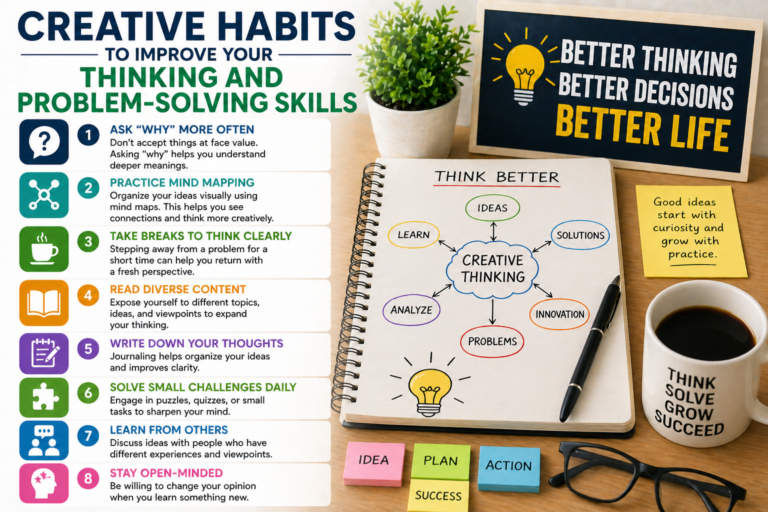
Try the Cornell Method or mind maps.
Revise On A Regular Basis Using Spaced Repetition.
Without review, the brain loses up to 70% of new information in just 24 hours Ebbinghaus Forgetting Curve.
The solution is to review material at increasing intervals after one day, three days, one week, and two weeks.
Combine this with active recall testing yourself instead of re-reading to improve long-term retention by up to 50%.
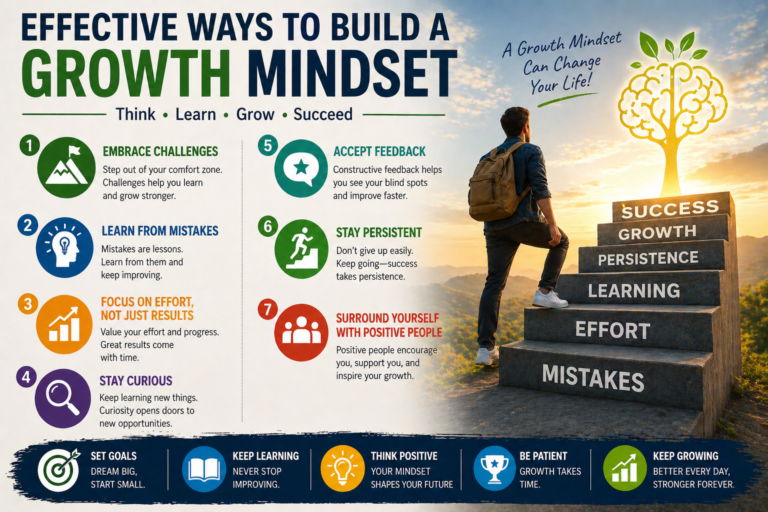
Maintain a positive attitude and protect your mindset.
According to Dr. In Carol Deck’s research, students who believe their abilities can be developed through effort outperform those who believe intelligence is fixed.
Celebrate small victories, set achievable daily goals, take short breaks, and refrain from comparing yourself to others.
Create a reward system 15 minutes of enjoyment after each focused session so that your brain associates studying with reward rather than punishment.
Conclusion
Begin with one habit this week.
Make it negotiable and add another.
Within a month, your academic life will be transformed.